Matcha Clay Mask
✨ Green tea lifts the day right off your face
Green tea clay that lifts the day away and leaves skin fresh as morning.
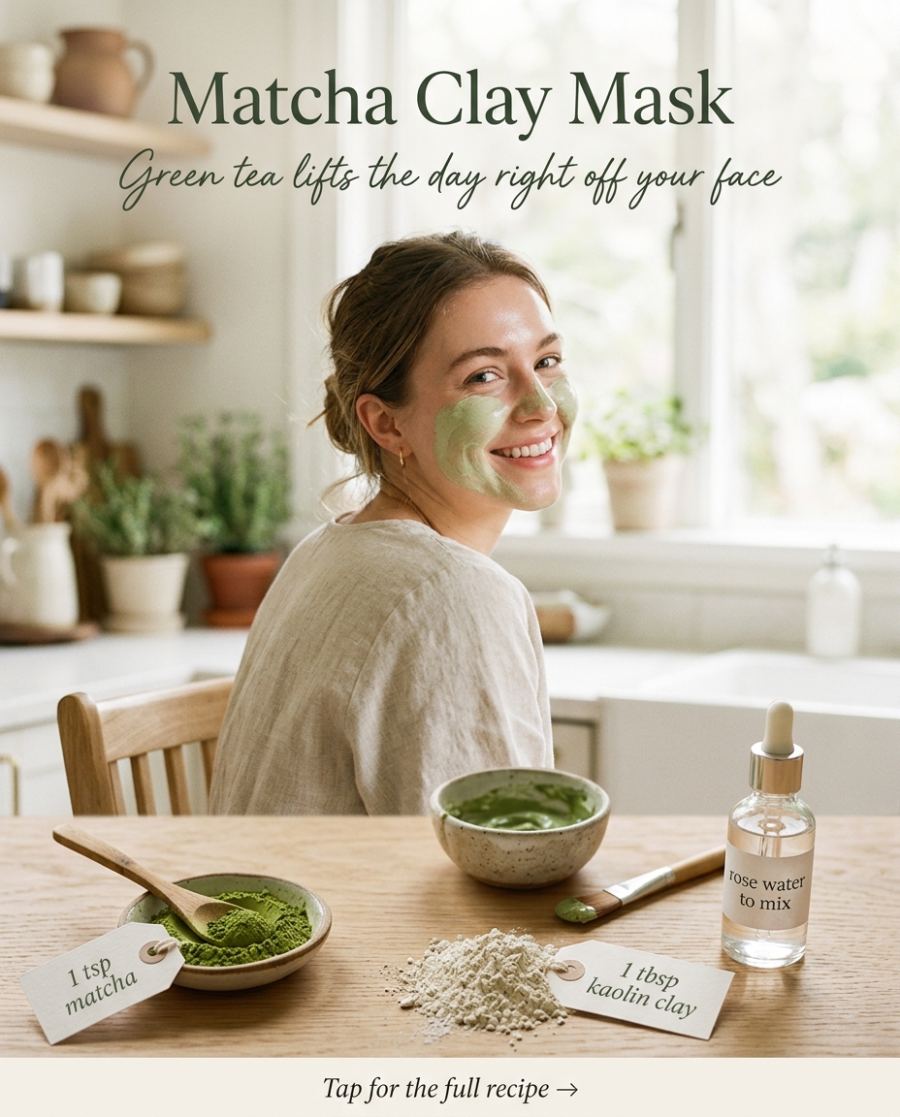
- 1 tsp matcha powderno matcha? use finely ground green tea leaves
- 1 tbsp white kaolin clayno kaolin clay? use thick oat-flour paste
- Rose water to mixno rose water? use cooled chamomile tea
- Whisk matcha and clay together.
- Add rose water drop by drop to a smooth paste.
- Smooth over skin, avoiding eyes.
- Rinse before it fully dries.
Kaolin is the softest of the cosmetic clays, which is precisely why it suits a weekly habit. Its fine, plate-like particles take up excess sebum and the day's grime, so oily and combination skin tends to rinse off feeling fresher — without the tight squeak that stronger clays leave behind. White kaolin absorbs politely rather than greedily.
Matcha is whole green tea leaf, milled to powder, and green tea is among the best-studied antioxidant ingredients in skincare. Its catechins — EGCG chief among them — may help calm the look of stressed, city-worn skin, and because you are using the entire leaf rather than a brew, the mask receives a concentrated dose from a single teaspoon.
Rose water is more than a mixer. It hydrates while the clay works, holds the paste at that all-important damp stage a little longer than plain water would, and leaves a soft floral note that turns ten practical minutes into something worth looking forward to.
The misstep that catches nearly everyone is pouring the rose water in all at once. Clay drinks unevenly, so a single splash gives you soup, then a rescue spoonful of clay gives you mortar, and the batch ends up double the size and twice as thick — the exact paste that crack-dries on your face. Add it genuinely drop by drop, stirring between each, and stop the moment it spreads like thin yoghurt.
You are aiming for a smooth, sage-green paste with a matte finish and a faint grassy-rose scent, spreading in one thin, even layer. On skin it cools first, then tightens slightly at the edges — that is your rinse cue. Cracking, flaking or an itchy, pulling sensation means it went on too thick or stayed too long.
- Rose water to mix → Cooled chamomile tea to mix On days your skin feels reactive and you want the plainest, calmest liquid possible.
- 1 tbsp white kaolin clay → 1 tbsp pink kaolin clay For normal-to-dry skin that finds even white clay a touch thirsty.
- 1 tsp matcha powder → 1 tsp finely milled green tea (blitz sencha leaves to powder) When good matcha feels too precious to spend on a mask.
Very dry, flaky or easily flushed skin will find even gentle clay a demanding guest — shorten the sit to five minutes or choose a cream mask instead. If you are new to clay masks altogether, start with a thin stripe on the jawline rather than the full face, and always patch test behind the ear the day before.
Once a week earns its keep — many people fold it into a Sunday-evening reset before the new week. Mask, rinse while still damp, then layer hydration generously on top. Keep scrubs and acid exfoliants on a different evening entirely; clay has already done the deep-cleaning, and doubling up leaves skin short-changed. Combination skin can paint the T-zone only.
Why can't the clay dry fully?
Bone-dry clay starts pulling moisture back out of your skin. Rinse while it's still slightly damp — that's the sweet spot.
How often for oily skin?
Once a week is enough — clay is powerful.
Can I mix it with plain water instead of rose water?
You can — the clay and matcha still do their work. Plain water dries a little faster on the face, so mix the paste a touch wetter and keep an eye on the edges. Rose water simply buys you more time in that ideal damp stage, plus the scent.
Does the grade of matcha matter?
Culinary grade is ideal here — save ceremonial for the teapot. What actually matters is purity: check the label is 100 percent milled green tea leaf, with no sugar, milk powder or latte blends, which behave on skin about as well as you would imagine.
It left a faint green tint on my skin — how do I shift it?
Sweep over a damp cotton pad with a little of your usual cleanser or micellar water and it lifts straight off. A lingering tint usually means the paste went on thick or dried too far, so next time mix it slightly looser and rinse a minute earlier.