Shea Whip Heel Butter
✨ Sandal-season heels in three nights
Shea whipped with castor oil, sealed under cotton socks — sandal-season heels in three nights.
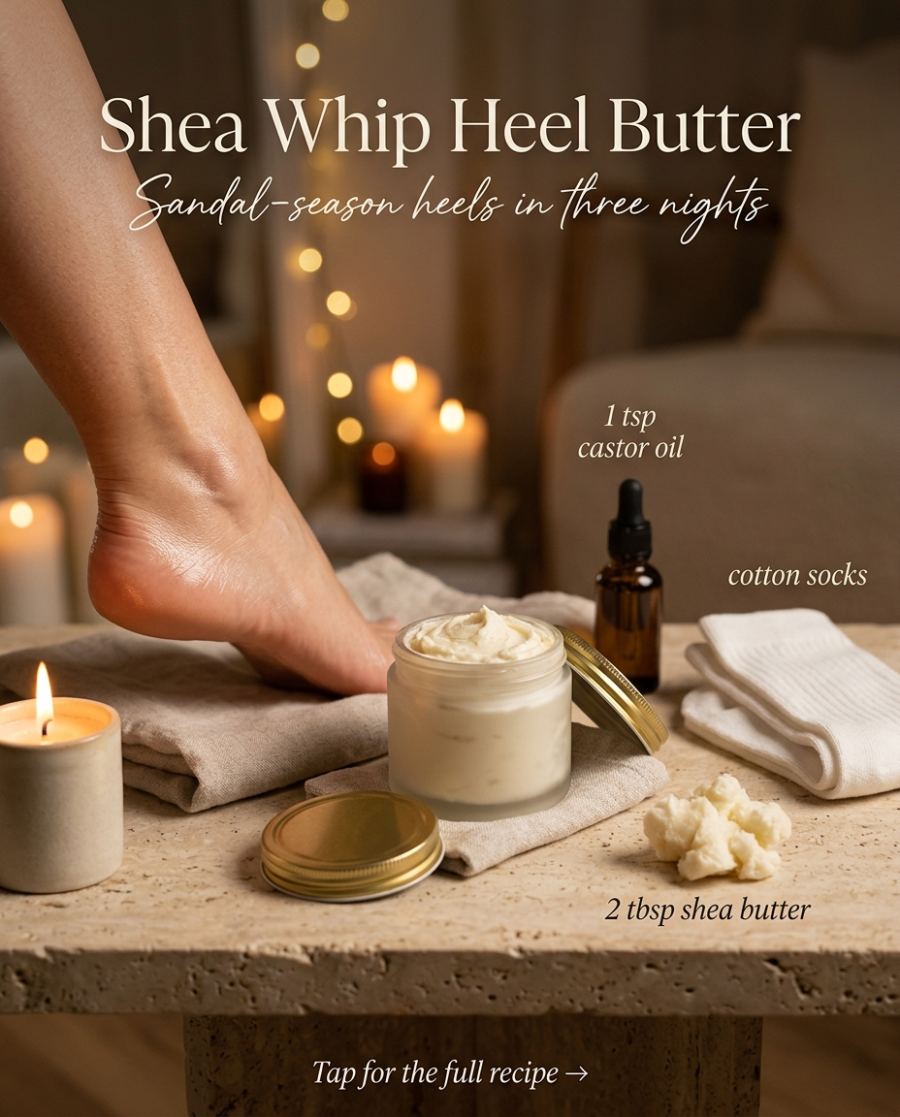
- 2 tbsp shea butterno shea butter? use chilled coconut oil
- 1 tsp castor oilno castor oil? use olive oil
- cotton socks
- Whip shea with castor oil to a thick cream.
- Massage generously into clean heels at bedtime.
- Pull on cotton socks.
- Repeat 3 nights; buff gently on night 4.
Heel skin is the thickest on the body, which is why ordinary lotion vanishes into it without leaving a trace. Shea butter behaves differently: its stearic and oleic fatty acids, plus a naturally high share of unsaponifiables, let it work into hardened keratin and stay put, softening from within rather than filming over the top.
Castor oil is the quiet workhorse of the pair. Ricinoleic acid — its dominant fatty acid — is thicker and clingier than most plant oils, so it slows the whip's absorption and keeps the treatment active across a whole night's sleep instead of an hour.
And the cotton socks are an ingredient, not an accessory. They hold warmth and stop evaporation, creating a mild occlusive pocket in which softened skin stays softened. Three consecutive nights lets that effect compound, which is why the gentle buff waits until night four: by then the hard edges have largely surrendered and lift away with barely any persuasion.
Impatience with the file is what undoes this recipe. People take a foot file to dry, cracked heels on night one, hoping to speed things along — and hard filing on unsoftened skin tends to invite deeper splits, not smoother heels. The order is the treatment: three nights of whip and socks first, then a light buff on softened skin. If night four still feels leathery, add more whip nights before you buff.
The whip should stand in soft peaks like a thick pale cream, with shea's faintly nutty, slightly smoky scent. Heels feel frankly waxy at lights-out — that is correct — and noticeably more supple by morning. A crayon-like or sharp rancid smell, or oil pooling on top of the jar, means the fats have turned; whip a fresh batch.
- 1 tsp castor oil → 1 tsp olive oil castor's drag bothers you during the massage — olive sinks in faster with a lighter feel
- 2 tbsp shea butter → 2 tbsp mango butter tree nuts are off the table in your home — it whips and softens in much the same way
- cotton socks → thin bamboo socks cotton leaves your feet overheating at night — bamboo seals the whip in while sleeping cooler
Give this a miss if tree nuts are an allergy in your world — shea is one — and hold off wherever cracks are deep enough to weep or bleed; let those close before treating. If your feet are under a clinician's regular care, ask before starting a nightly ritual. Otherwise, patch test a little whip on the inner ankle overnight first.
Run it as a Monday-to-Thursday ritual: whip and socks on three consecutive nights, the gentle buff on the fourth, then let heels go bare over the weekend. Strictly a bedtime affair — the whip is far too rich for daytime shoes. One cycle a month keeps sandal season honest, and you can simply skip a month when heels are already smooth.
Really only 3 nights?
For most heels, yes — deep cracks may ask for a week.
Can I add peppermint?
One drop for the spa feeling — lovely.
Will it work on rough elbows or gardening hands?
Beautifully — the same whip suits any patch of thickened, hard-working skin. For hands, massage it in at bedtime and swap the socks for clean cotton gloves; for elbows, a long-sleeved old top does the sealing. Expect similar timing: a few nights, then reassess.
Do the socks truly have to be cotton?
The fibre matters more than the brand. Cotton and other breathable naturals hold warmth while letting sweat escape, so skin softens without going soggy. Synthetic socks trap moisture against the heel all night, which leaves skin waterlogged rather than supple — not the finish you are after.
How do I whip it without an electric mixer?
A fork and a firm wrist manage nicely. Let the shea soften at room temperature until a fork dents it easily — softened, never melted — then add the castor oil and beat vigorously for two to three minutes. Melted shea will not hold air, so patience beats the microwave here.